Mare Breeding Services & Foaling — Artificial Insemination, Embryo Transfer, Recipient Mares — Equine Reproduction | Oak Grove Veterinary Hospital

Small animal + equine care in Coweta

Talk with our team: 918-486-VETS

Home › Equine Reproduction

Equine services · Coweta, Oklahoma

Mare Breeding Services & Foaling — Artificial Insemination, Embryo Transfer, Recipient Mares

Three decades of reproductive excellence — mare management, fresh, cooled and frozen semen, embryo transfer and foaling care, led personally by Dr. Jay Ross.

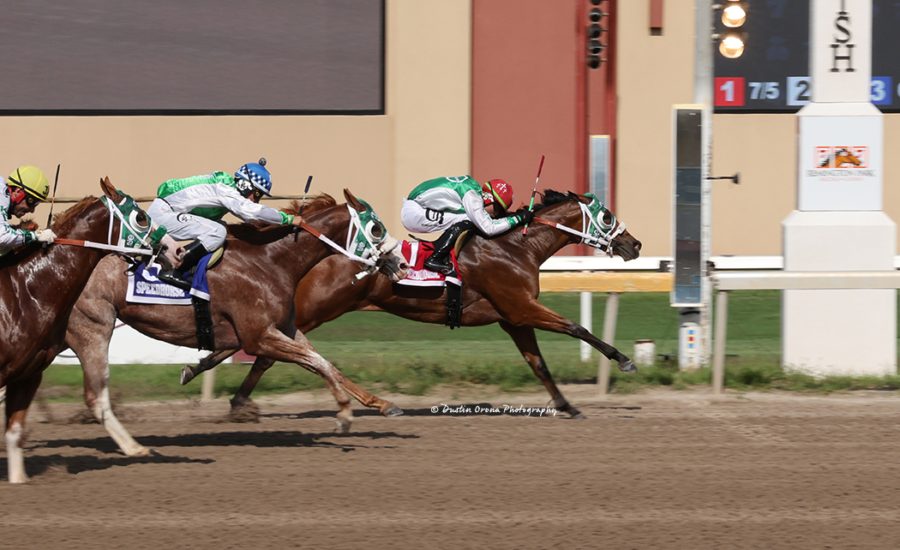
Vesper Martini winning the 2025 Speedhorse Graham Paint & Appaloosa Stakes (G1) at Remington Park
30 years of
reproductive excellence.

Reproduction, run like a program — for 30 years.

From the first ultrasound to the sales ring: mares, stallions, embryos and foals under one roof in Coweta.

Mare management & breeding

Three decades of reproductive excellence. Oak Grove has led equine reproduction in northeast Oklahoma for 30 years — flushing embryos before hardly anyone in the region was doing it. From embryo transfer and vitrification to stallion collection, cooled and frozen semen shipping, foaling-out and neonatal intensive care, we take horses from conception to the sales ring: 15 to 25 head prepared for the Ruidoso Select Sale nearly every year for three decades, trusted with some of the finest Quarter Horses and Paints in Oklahoma — and the nation. For the full start-to-finish picture — the mare, the foal, and the radiograph reckoning — read our guide to raising a sale yearling.

Cycle monitoring
Ultrasound palpation and timed breeding management.
Breeding soundness
Reproductive evaluation to plan a mare’s season — the starting point of a managed breeding program.
Breed Her Early
Our pre-season push for 2027: fall breeding soundness exams, lights on December 1, and breeding and foaling capacity reserved by December 15. See the Breed Her Early plan
Artificial insemination
Fresh, cooled and shipped semen.
Deep horn insemination
For low-volume, limited or irreplaceable doses — frozen semen, a shipment that arrives short, a single straw that has to count — the dose is deposited deep in the uterine horn on the side of the coming ovulation, putting a small volume exactly where it does the most good. It’s the technique that makes scarce semen breed like it isn’t.
Frozen semen
The most demanding breeding we do. Frozen semen lives only hours in the mare, so the window is unforgiving: mares are examined by ultrasound every six hours as ovulation approaches, insemination is timed to the hour, and every dose is evaluated after thawing before it is used — critical when a dose is limited or irreplaceable. The same precision carries into the embryo work frozen semen so often serves: flushing embryos on schedule, vitrifying them for storage or shipment, or transferring them fresh into synchronized recipients. Frozen semen takes more intense management to succeed, and that management is a program we have run for three decades.

Embryo transfer & vitrification

Embryo transfer
Flush, transfer, and vitrification. The full program — donor management, the embryo’s three roads, and the recipient side — has its own page: embryo transfer at Oak Grove.
Embryo vitrification
Embryos vitrified here at Oak Grove — frozen on site for storage or shipment, handled with the same schedule discipline as our frozen semen work.
Fresh transfer
Embryos transferred fresh into synchronized recipient mares.

Stallion services

Stallion services
Full stallion management for the stallions standing here with us — day-to-day care, collection schedules, semen evaluation on every dose, and cooled and frozen shipping out. The stallion side has its own page: stallion services at Oak Grove.
Semen collection
Collection and evaluation, with every dose assessed before it is used.
Cooled & frozen shipping
Cooled and frozen semen shipped out — and evaluated after thawing when it comes in.

Foaling & neonatal care

Foaling services
Foaling-out and neonatal care under veterinary supervision — including angular limb deformity management, neonatal plasma administration, intensive foal care, and nutritional management for growing foals. How foaling-out works here, start to finish: foaling services at Oak Grove.
Year-round mare care
Broodmare management through every stage.
ReproductionEmbryo transferEmbryo vitrificationFrozen semenFoaling servicesStallion managementSemen collectionCooled semen shipping

Serving horse owners across northeastern Oklahoma — Coweta, Broken Arrow, Wagoner, Tulsa, Bixby, Jenks, Owasso, Claremore, Muskogee — and welcoming haul-in clients from Kansas, Missouri, Arkansas, and Texas.
The proof: horses this program produced.

This isn’t theory. These are horses Oak Grove helped produce and manage for their owners — from the breeding shed and the foaling barn to the racetrack — under the same start-to-finish program described on this page. Combined earnings of the horses below: more than $3.7 million. Records verified against StallionSearch, Equibase and AQHA records, October 2026. For the full story of how a yearling gets from the breeding shed to the sale ring, read our guide to raising a sale yearling.

Party Politics — SI 94 · $1,113,056
Won the Golden State Million Futurity (G1) and the Ed Burke Million Futurity (G1), and the Golden State Derby (G2). By Apollitical Jess out of Shanachee.
Bon Accord — SI 105 · $821,470
Won the Remington Park Invitational Championship (G1) and the Go Man Go Handicap (G1); second in the All American Derby (G1).
Celtic Emblem — SI 96 · $577,377
Won the Easy Jet Stakes (RG3), second in the All American Derby (G1); Oklahoma champion 3-year-old filly. Now a producer.
Dutch Schultz — SI 99 · $356,668
Grade 2 winner.
Answer The Dream — SI 99 · $264,375
Won the Juno’s Request Stakes (G3) at Remington Park. Oak Grove produced offspring for her owners and managed the mare through the vast majority of her life.
Nellie Delaney — SI 96 · $211,305
Won the Southern California Derby (G1) and the Los Alamitos Winter Championship (G1). Now the dam of a Grade 1 winner.
Shanachee — SI 98 · $124,478
Dam of Party Politics and of multiple graded stakes winner O Donovan Rossa (SI 112, $432,169).
Point Blank Range — $192,413
Won the Heritage Place Derby (G2) and was named Remington Park’s champion 3-year-old male. Dr. Ross was the veterinarian who produced three generations of this family for the breeder — the second dam, her daughter, and Point Blank Range himself. 918 Bloodstock, in which Dr. Ross is a partner, bought him as a yearling and campaigned him to the Derby win.
Fenian Faith — SI 97 · $83,970
Graded-stakes placed, and still in the program today — bred for a January 2027 foal. The work on this page is current, not history.

Recipient mares & the embryo program.

A donor mare’s value doesn’t have to stop at one foal a year — but embryo transfer only works if the receiving end is ready when the embryo is. We don’t keep a recipient herd of our own; instead, we work with multiple recipient herds, and that keeps the program fluid — we never get bound up by a limited number of recipient mares, and we aren’t limited on how many transfers we can handle in a season. We can run the whole process end to end. The transfer work itself runs both ways, in whatever proportion the season dictates: some fresh transfers done here, some embryos shipped to a recipient standing somewhere else.

Fresh transfers, done here
When a synchronized recipient is ready, fresh embryo transfers are performed at Oak Grove as part of the donor’s breeding work.
Embryos shipped, too
Plenty of embryos never transfer here at all — they ship, fresh or vitrified, to the recipient wherever she is standing. Season to season, the work is a mixture of the two, and we plan the donor around whichever end she’s headed for.
Multiple recipient herds
Working across several recipient herds keeps synchronized mares available when a donor is ready — the program doesn’t stall waiting on one small group of mares, and the inventory stays broad enough to take the season as it comes.
Oklahoma-Bred enrollment
Recipient mares in the program are enrolled in the Oklahoma-Bred program as part of the season’s work, so the foal’s eligibility is protected.
One record per mare
Every recipient tracked by collar number and microchip, with per-owner lists — an embryo owner always knows exactly which mares are carrying for them.

Questions mare owners ask us.

The same answers we give at the barn rail — plain, and before the season is on the line.

When should my mare go under lights?
Late fall. Sixteen hours of light and eight of dark, starting around Thanksgiving — our program turns lights on December 1 — pulls a mare’s first ovulation of the year forward into late January or early February, instead of waiting on spring. That’s the difference between a mare bred on the first cycle of the season and a mare still transitioning in March. See the Breed Her Early plan.
How does embryo transfer work, start to finish?
The donor mare is bred and monitored like any breeding. About a week later — day 7 or 8 — the uterus is flushed and the embryo recovered and graded. From there it goes one of two ways: transferred fresh into a recipient mare whose cycle was synchronized to the donor’s, shipped to a recipient standing at another program, or vitrified — frozen — for storage or later shipment. The recipient is then pregnancy-checked on schedule and managed through foaling.
Fresh, cooled, or frozen semen — what changes?
The management. Fresh semen on site is the simplest. Cooled, shipped semen gives roughly a day’s working window, so timing is planned around the shipment. Frozen semen lives only hours in the mare — mares are examined by ultrasound every six hours as ovulation approaches, the insemination is timed to the hour, and every dose is evaluated after thawing before it is used. It’s the most demanding breeding we do, and we’ve run the program for three decades.
My mare is a problem breeder. Where do we start?
With a breeding soundness exam — culture, cytology and biopsy where they’re called for — and a hard look at her history: cycles, prior breedings, prior foals. Most “problem mares” have a findable reason: fluid that isn’t clearing, an infection that was never fully resolved, timing that was never right. Find it first, then build the season around it — that’s cheaper than breeding her four times and hoping.
When do I need to book for the 2027 season?
Now. Breeding soundness exams happen in the fall, lights go on December 1, and breeding and foaling capacity for the season is reserved by December 15. Stallion books close and recipient availability tightens as the season fills — the owners who plan in November breed in February. Call 918-486-8387.

More care at Oak Grove.

Every service on the site, one click away.

Boarding

Dog, cat and equine boarding with attentive daily care.

Explore boarding

Equine care

The general equine practice — working, performance and breeding horses.

Explore equine care

Back to the homepage

The whole practice on one page — care, boarding, pharmacy and client stories.

Return home

Mare care guides.

Season calendars and pregnancy timelines from our reproduction program — plan the breeding year before it plans you.

Caring for the pregnant mare

Trimester by trimester — feeding, the EHV-1 series, and 30-day-out foaling prep.

Read the pregnant mare guide

What it costs to breed a mare

There is no single number — there is a list of steps. Walk through every one before the season starts.

Read the breeding cost guide

Plan your visit

We’re easy to reach.

918-486-VETS
Find us

12949 South State Highway 51
Coweta, Oklahoma 74429

Weekdays

Monday–Friday · 8:00 AM–5:30 PM

Weekend

Saturday · 8:00 AM–12:00 PM
Sunday · Closed

Emergency

After-hours emergency (small animal): Animal Emergency Center of Tulsa, 4055 S 102nd E Ave, Tulsa, OK — open 24 hours a day. Call (918) 665-0508

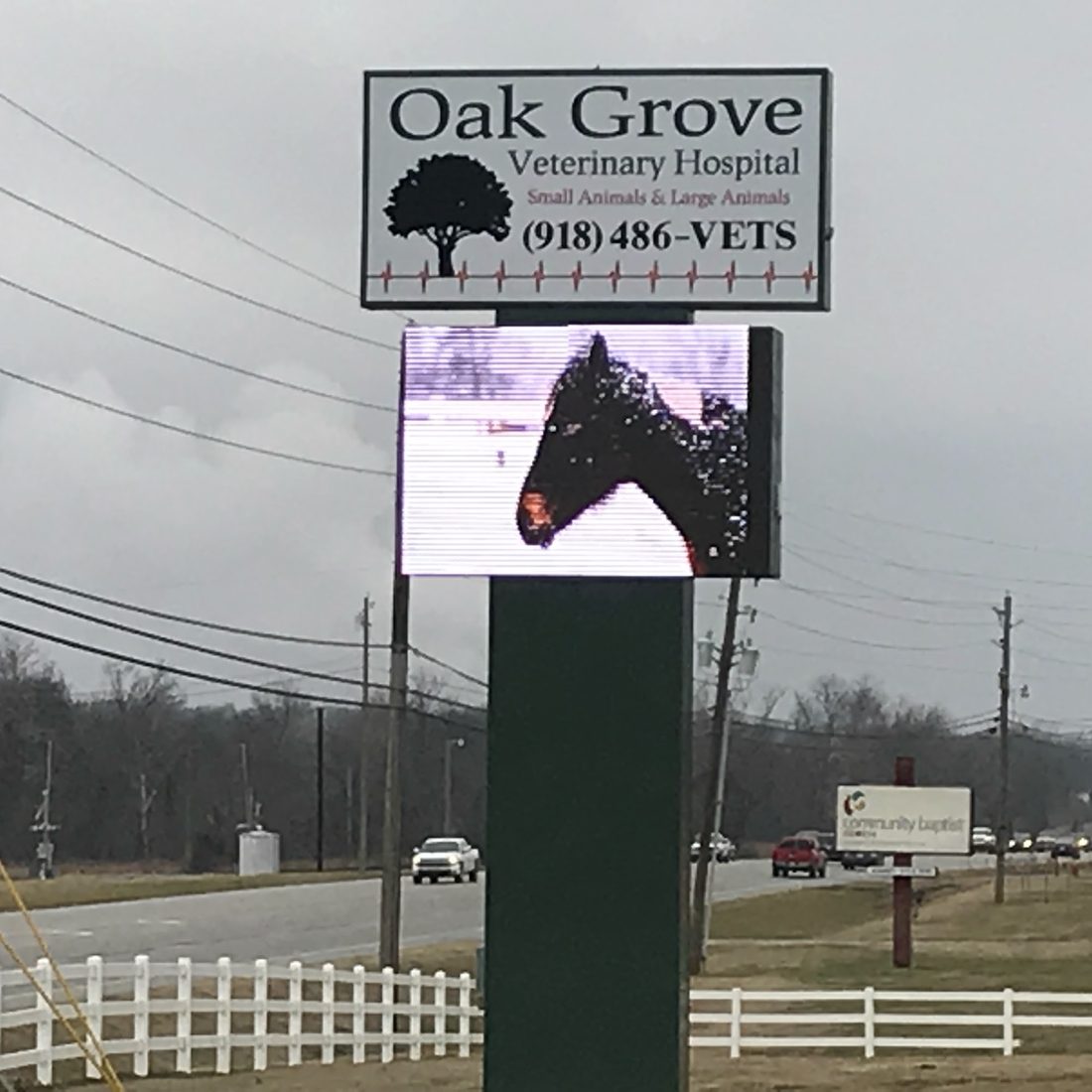
Oak Grove Veterinary Hospital roadside sign on Highway 51 in Coweta
Call 918-486-VETS