Equine Regenerative Medicine — RenoVo® Amniotic Allograft for Tendon, Ligament & Joint Injuries | Oak Grove Veterinary Hospital

Small animal + equine care in Coweta

Talk with our team: 918-486-VETS

Home › Regenerative Medicine

Equine services · Coweta, Oklahoma

Equine Regenerative Medicine — RenoVō® for Tendon, Ligament & Joint Injuries

For the bowed tendon, the suspensory that won’t come right, the joint that needs more than maintenance — regenerative therapy built around RenoVō®, an amniotic tissue allograft, and chosen off a full lameness workup with Dr. Jay Ross. Not off a menu.

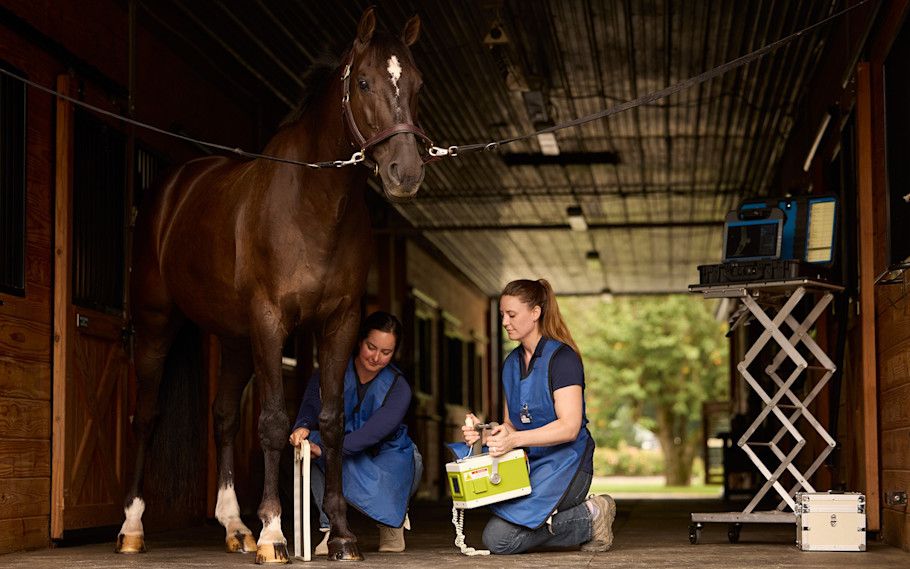
A veterinary team positioning a portable radiograph unit at a horse's front leg in a barn aisle
Diagnosis first.
Treatment second.

Regenerative medicine, in plain terms.

Most lameness treatment manages pain and inflammation. Regenerative medicine aims at the tissue itself — delivering the biological signals healing runs on, to the exact place that’s torn, strained or worn.

Support the repair — don’t just quiet the pain

When a tendon or ligament tears, the body fills the gap with scar — tissue that’s weaker and stiffer than what it replaced, and prone to tear again. Pain control has its place, and rest is non-negotiable, but neither one improves what the repair is made of. Regenerative therapies work the other side of the problem: they bring growth factors, cytokines and matrix proteins — the raw materials and the instructions of tissue healing — directly into the lesion or the joint, to support a better-quality repair. At Oak Grove, regenerative therapy lives inside the sports medicine program: it starts with the workup described on our sports medicine & lameness page, and it’s prescribed the way everything here is — off the diagnosis, not off a package.

RenoVō® — the amniotic allograft we reach for

What it is
A liquid, acellular allograft made from equine amniotic tissues — amnion and amniotic fluid, the tissues that surround a foal through pregnancy. “Allograft” means it comes from a donor horse rather than from the patient; “acellular” means it carries the tissue’s biological factors, not living cells. It’s cryopreserved — kept frozen to protect the proteins that make it useful — and administered by injection, into a lesion under ultrasound guidance or into a joint, by a licensed veterinarian.
What’s in it
The growth factors, cytokines, amino acids, hyaluronic acid and extracellular matrix proteins naturally present in amniotic tissue — including IL-1ra and alpha-2-macroglobulin (A2M), two of the proteins most associated with calming inflammation and protecting tissue while it heals. Amniotic tissues carry reported anti-inflammatory, anti-bacterial and anti-fibrotic properties — part of why a foal can develop safely in them, and part of why they’re used to supplement and protect injured tissue.
Where it comes from
The tissues are recovered from healthy mares during live birth, collected by licensed veterinarians with sterile technique, without harm to the mare or the foal — tissues that would otherwise be discarded after foaling. The finished product is aseptically processed, sterility-tested and made to a standardized formulation in three volumes, so every dose is the same — which is not something a product drawn from the patient that morning can promise.
Why a prepared product matters
The older regenerative route manufactures the therapy out of the patient — a blood draw and lab processing for PRP or IRAP, a bone-marrow or fat harvest for stem cells, sometimes weeks of cell culture. RenoVō skips all of it: no harvest procedure on an already-injured horse, no culture wait, no on-site preparation. When the workup says a lesion should be treated, the graft is in the freezer and the horse is treated on the diagnosis’s schedule — not the laboratory’s.

The cases it’s used for

Tendon & ligament injuries
Tendonitis and desmitis — bowed tendons, suspensory injuries, deep digital flexor lesions — where the goal is a stronger, better-organized repair in tissue that heals slowly and scars easily.
Soft tissue that has stalled
Injuries that have been through rest and first-line treatment and plateaued, including soft-tissue injuries that haven’t responded to initial treatment — where the lesion needs a biological push rather than more of the same.
Joints
Administered into the joint to supplement and protect the tissues there, as one tool in managing the working joints of a performance horse — chosen off what the blocks and imaging found in that joint.
Wounds
The manufacturer also lists wounds among the product’s common uses — and amniotic tissue in wound care is the oldest application of all, with published work on it going back more than a century.

Whether RenoVō fits your horse is a workup answer, not a phone answer — the lesion’s location, age and severity, and what the ultrasound shows, decide it. Some injuries need surgery, some need a different therapy, and some need time more than anything we can inject.

Regenerative medicineRenoVō®Tendon & ligamentSports medicineLamenessJoint therapyUltrasound-guided injection

Serving horse owners across northeastern Oklahoma — Coweta, Broken Arrow, Wagoner, Tulsa, Bixby, Jenks, Owasso, Claremore, Muskogee — and welcoming haul-in clients from Kansas, Missouri, Arkansas, and Texas.
How a case runs at Oak Grove.

Regenerative therapy is a program, not an injection. The injection is the middle of it.

1 · The workup comes first
History, hands-on exam, movement evaluation and diagnostic blocks to localize the lameness — then ultrasound and radiographs to see the lesion itself. No regenerative product is chosen before the injury is actually identified. That’s the rule the whole sports medicine program runs on.
2 · The diagnosis picks the therapy
If the lesion is a candidate — right tissue, right stage, right horse — RenoVō goes on the plan. If it isn’t, you’ll hear that instead, along with what fits better: joint therapy, laser, acupuncture, a surgical conversation, or a rehab-only plan.
3 · Treatment day
The graft is thawed and injected into the lesion under ultrasound guidance, or into the joint, with the horse sedated and the site prepared sterile. Because the product is ready-made, treatment day is one procedure — there’s no harvest step and no second event to manufacture the therapy first.
4 · Rehab with milestones
Tissue heals on a schedule measured in months. The plan is written down: stall rest, hand-walking, controlled exercise steps — each one gated by how the horse exams, not by the calendar alone.
5 · Rechecks that measure
Follow-up ultrasounds compare the lesion against itself — fiber pattern, size, organization — so “is it working?” gets answered with images. If the repair stalls, the plan changes on evidence. The full workup is described on our equine sports medicine & lameness page.

Honest expectations.

What regenerative therapy can do, and what it can’t — before you spend anything on it.

Regenerative therapy supports healing; it does not guarantee it — and any practice that promises a tendon back to brand-new is selling something. Tendons and ligaments heal slowly even with the best biology we can deliver, and the outcome rides on things no injection controls: the size and age of the lesion, the horse’s job, and whether the rehab plan is actually followed at home. What RenoVō changes is the quality of what’s present at the injury site while the body does the work. At the workup we’ll tell you whether your horse’s lesion is the kind this helps, what a good result realistically looks like, and what the rechecks should show — and if the honest answer is that he isn’t a candidate, that’s the answer you get.

Questions owners ask us.

The same answers we give at the barn rail — plain, and before anybody books a treatment.

What is RenoVō, exactly?
A liquid, acellular equine amniotic tissue allograft — made from amnion and amniotic fluid, the tissues that surround a foal during pregnancy. It’s cryopreserved and kept frozen to preserve its biologically active factors — growth factors, cytokines, hyaluronic acid and matrix proteins, including IL-1ra and A2M — and it’s labeled to supplement and protect tissues. Because it’s acellular, it delivers those factors without living donor cells.
Does my horse have to give blood or bone marrow first?
No — that’s the practical difference. Autologous therapies like PRP, IRAP and stem cells are manufactured out of the patient, which means a blood draw and processing, a marrow or fat harvest, or weeks of cell culture. RenoVō is prepared ahead of time from donor tissue, sterility-tested and standardized, and stored frozen — ready when the diagnosis says treat, with no harvest procedure on an already-injured horse.
What kinds of injuries is it used for?
Mostly tendon and ligament injuries — tendonitis, suspensory desmitis, deep digital flexor lesions — including soft-tissue injuries that haven’t responded to initial treatment. It’s also used in joints, and the manufacturer lists wounds among its common uses. Whether it fits a specific horse is decided by the lameness workup and the ultrasound, not by the injury’s name alone.
Where does the tissue come from — is it safe for the donor?
From healthy mares at live birth. The amniotic tissues are recovered by licensed veterinarians using sterile equipment, without harm to the mare or the foal — tissues that would otherwise be discarded after foaling. The finished product is aseptically processed and sterility-tested, is available by prescription only, and is administered by a licensed veterinarian.
Will it fix my horse?
It supports healing; it doesn’t guarantee it. Tendon and ligament repairs are measured in months, and the result depends on the lesion and on the rehab that follows. What we can promise is the process around it: a real diagnosis first, a straight answer on candidacy, treatment under ultrasound guidance, and recheck imaging that shows whether the tissue is actually improving.

More care at Oak Grove.

Every service on the site, one click away.

Equine reproduction

Mare breeding services and foaling — AI, embryo transfer, recipient mares and stallion services.

Explore equine reproduction

Equine care

The general equine practice — working, performance and breeding horses.

Explore equine care

Boarding

Dog, cat and equine boarding with attentive daily care.

Explore boarding

Back to the homepage

The whole practice on one page — care, boarding, pharmacy and client stories.

Return home

Plan your visit

We’re easy to reach.

918-486-VETS
Find us

12949 South State Highway 51
Coweta, Oklahoma 74429

Weekdays

Monday–Friday · 8:00 AM–5:30 PM

Weekend

Saturday · 8:00 AM–12:00 PM
Sunday · Closed

Emergency

After-hours emergency (small animal): Animal Emergency Center of Tulsa, 4055 S 102nd E Ave, Tulsa, OK — open 24 hours a day. Call (918) 665-0508

Oak Grove Veterinary Hospital roadside sign on Highway 51 in Coweta
Call 918-486-VETS