Equine Pre-Purchase Exams — Horse Vet Checks, Radiographs & Drug Screening | Oak Grove Veterinary Hospital

Small animal + equine care in Coweta

Talk with our team: 918-486-VETS

Home › Equine Pre-Purchase Exams

Equine services · Coweta, Oklahoma

Equine Pre-Purchase Exams

Know the horse before the money changes hands. From a basic clinical exam to full radiographs, ultrasound and send-off drug screening — scaled to the horse, the job, and what you have at stake, with Dr. Jay Ross in Coweta, Oklahoma.

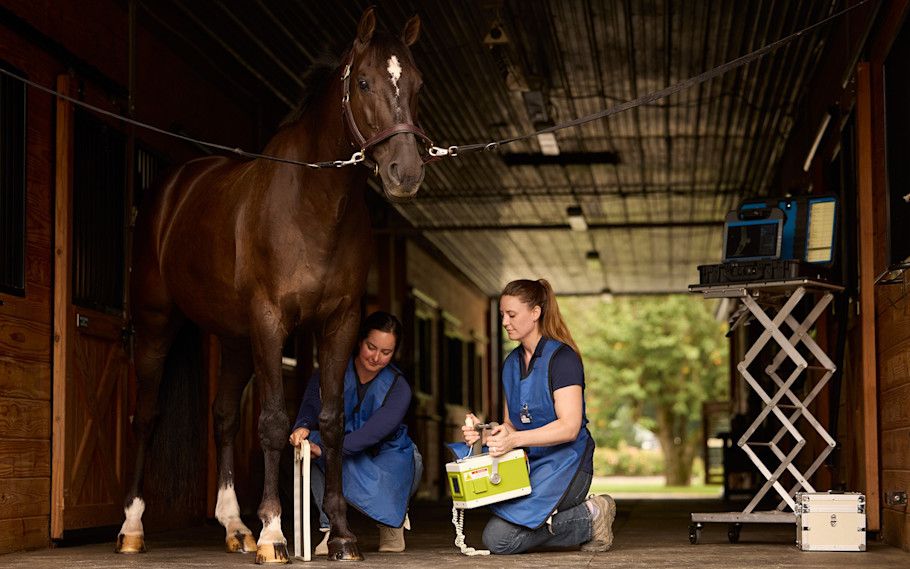
Digital radiograph of a yearling horse's leg at Oak Grove Veterinary Hospital
Know before
you buy.

The exam scales to the horse — and to the decision.

A pre-purchase exam is not a pass/fail test, and it is not one fixed package. It is the buyer’s exam: we examine, we explain what we find in plain terms, and the buy-or-walk-away call stays where it belongs — with you.

Level 1 · The clinical exam

History first
The horse’s record as the seller presents it — training, racing or showing history, prior injuries, medications, vices — checked against the horse standing in front of us.
Eyes, heart & lungs
A full physical: ophthalmic exam, heart and lung auscultation before and after exercise, temperature, gut sounds, body condition and overall health.
Conformation & feet
How the horse is built and how it is shod — the structure the next ten years of work will stand on, with hoof testers applied to every foot.
Movement & flexions
Watched at the walk and trot, in hand, on the straight and the circle, with flexion tests joint by joint — the same process that anchors our lameness workups.

Level 2 · Imaging

Digital radiographs
X-rays of the areas that matter for the horse’s intended job — hocks, stifles, fetlocks, feet, knees — taken and read in-house, so the answer comes the same visit.
Ultrasound
Tendons and ligaments on a performance prospect, or a reproductive ultrasound on a broodmare prospect — including the breeding soundness picture that decides what a mare can do next season.
Chosen, not packaged
Imaging is picked for this horse and this job, not run off a menu. We will tell you which views earn their keep — and which ones don’t.

Level 3 · Lab & drug screening

Bloodwork
A blood panel through our in-house lab — the general-health picture behind the horse you are looking at.
Drug screening, sent off
A blood sample drawn at the exam and sent to an outside laboratory for drug screening — so you know nothing was on board masking pain or changing the horse you saw. Results return in days and are added to the report.

The written report

Findings, documented
Everything found — clinical, imaging and lab — written up for the buyer, in language a non-veterinarian can act on.
Usable for insurance
A documented exam and report you can put in front of an insurance company when the horse is insured — the paper trail starts on day one.
The buyer’s copy
The report belongs to the buyer who commissioned it. What is found is explained, not softened — and not shared around.
Pre-purchase examsVettingsDigital radiographsUltrasoundDrug screeningWritten report

Serving horse owners across northeastern Oklahoma — Coweta, Broken Arrow, Wagoner, Tulsa, Bixby, Jenks, Owasso, Claremore, Muskogee — and welcoming haul-in clients from Kansas, Missouri, Arkansas, and Texas.
Find it now, not after the wire clears.

The point of the exam, stated plainly: find the problems that are there today, and head off the ones that would find you later — for this horse, and for the job you are buying it to do.

A soundness question, answered straight
A horse can be bright, fat and friendly and still carry a hock that won’t hold up to the job. The exam exists to put facts where impressions were — before money changes hands, not after.
Matched to the intended job
A finding only matters against the work the horse will actually do. A trail prospect, a barrel prospect and a stakes prospect are three different standards — tell us the job, and the exam is read against it.
No pass, no fail
We don’t pass horses and we don’t fail them. We report what we find and what it means; the decision — buy, renegotiate, or walk away — is the buyer’s. That is how a vetting is supposed to work.

Built for the way horses change hands here.

Oak Grove sits in the middle of Oklahoma’s racing and breeding country. The horses we vet are the horses this region trades.

Yearlings & sale horses
Yearlings bought at the sales or privately, headed for the track or the next ring — radiographed and examined with the racing job in mind. Our reproduction program prepares sale yearlings of its own every year; we know what the other side of the transaction is looking at.
Race & performance prospects
Horses in training and horses changing barns — the full workup, imaging and drug screen available when the money and the future both argue for looking hard.
Broodmare prospects
A mare bought to breed gets the reproductive exam with the purchase exam — soundness for the job she’s actually being hired for. The breeding side of the practice is one floor away: equine reproduction at Oak Grove.
One visit, one report
Clinical exam, in-house imaging and lab, and the written report — coordinated in a single haul-in visit wherever the horse and the clock allow.

Questions buyers ask us.

The same answers we give at the trailer, before the exam starts.

How long does a pre-purchase exam take?
A basic clinical exam runs about an hour. Add radiographs or ultrasound and plan on a couple of hours, most of it while you wait. Drug screening is sent to an outside laboratory, so those results come back in days rather than the same visit — the written report is completed once they are in.
Should the seller be at the exam?
Usually the seller or their agent presents the horse and provides its history, and the buyer is welcome to be there too. But the exam is performed for the buyer: the findings are the buyer’s, explained to the buyer, and reported to the buyer.
Do I need radiographs on a young horse?
It depends on the horse’s intended job and what is at stake. A yearling headed for the track or the sale ring is commonly radiographed as a standard set, because joints that feel fine in hand can carry findings that matter later. Tell us what the horse will do and we will tell you honestly which views earn their keep.
What happens if something is found?
Most findings are management notes, not deal-breakers. We explain what a finding means for the job you have in mind, in plain terms, and the decision is yours — accept it, renegotiate, or walk away. There is no pass or fail on a pre-purchase exam; the veterinarian reports, the buyer decides.
Can you examine a horse I’m buying at a sale, or from out of the area?
Yes — horses are hauled in to our Coweta hospital for vetting from across the region. Sale purchases often run on a short clock, so call 918-486-8387 as early as you can and we will tell you straight what can be done in the window you have.

More care at Oak Grove.

Every service on the site, one click away.

Boarding

Dog, cat and equine boarding with attentive daily care.

Explore boarding

Back to the homepage

The whole practice on one page — care, boarding, pharmacy and client stories.

Return home

Plan your visit

We’re easy to reach.

918-486-VETS
Find us

12949 South State Highway 51
Coweta, Oklahoma 74429

Weekdays

Monday–Friday · 8:00 AM–5:30 PM

Weekend

Saturday · 8:00 AM–12:00 PM
Sunday · Closed

Emergency

After-hours emergency (small animal): Animal Emergency Center of Tulsa, 4055 S 102nd E Ave, Tulsa, OK — open 24 hours a day. Call (918) 665-0508

Oak Grove Veterinary Hospital roadside sign on Highway 51 in Coweta
Call 918-486-VETS